
SES Universities Lead the Way in Impact

The Knowledge Exchange Framework (KEF) data highlights how Science and Engineering South (SES) universities are leading the way on society and the economy.
The framework benchmarks how well England’s universities contribute to economic growth and delivering wider benefits. Notably, the results places SES universities at the forefront for research partnerships, IP and commercialisation, and public and community engagement.
From partnerships with businesses to pioneering spinouts, SES universities consistently show strong performance across KEF’s six thematic clusters, (explained in the diagram below) underscoring our role in fostering economic growth and positive community outcomes.
What is KEF?
The Knowledge Exchange Framework (KEF) is an annual assessment by Research England that evaluates how English universities collaborate with the wider economy and society to benefit the public, businesses, and communities. It groups universities into clusters to compare their performance in areas including research partnerships, working with business, and commercialisation. It is used by universities to improve their own performance and by external partners to find expertise.
Universities teach students and conduct research that produces new, valuable knowledge. But they also work with a broad spectrum of partners to turn that knowledge into tangible benefits for the economy and society. This process is known as knowledge exchange.
Universities collect data and also submit a short narrative to add context in areas where metrics are limited or unavailable, such as public and community engagement, and local growth and regeneration.
KEF aims to:
- Assess the quality and knowledge exchange among UK universities
- Enable comparison and improvement by benchmarking performance across institutions
- Highlight how universities are collaborating with external organisations, supporting local communities and helping to launch new ventures
KEF Dashboards
The KEF dashboards offer a visual snapshot of how higher education providers perform across seven key areas of knowledge exchange, referred to as ‘perspectives’. These are presented in a polar area chart, where each segment reflects a different aspect of engagement. The larger a segment appears, the stronger that institution’s activity in that area compared to others.
Cluster V
Cluster V encompasses 17 institutions in total, which includes all Science and Engineering South universities. The purpose of clustering is to ensure fair benchmarking. Institutions are compared to other universities with similar scale and research characteristics, rather than the entire HE sector.
The KEF Clustering report from Research England define Cluster V as:
“Very large, very high research intensive and broad-discipline universities undertaking significant amounts of excellent research. Research funded by range of sources including UKRI, other government bodies and charities; 10.2% from industry. Significant activity in clinical medicine and STEM. Student body includes significant numbers of taught and research postgraduates.”
The data shows that research-intensive universities performed very well on IP and commercialisation. Only 12 universities finished in the top 20% of institutions for “engagement” in all categories used by the KEF, which includes all SES universities.
SES Success
The latest KEF results highlight clear common threads across the Science and Engineering South (SES) universities. We are large, research-intensive, broad-discipline universities, producing high volumes of research across science, engineering, medicine and technology.
There is a shared focus on knowledge exchange: working collaboratively with business, industry, and communities as a core part of our mission.
SES universities typically have high levels of IP and commercialisation activity with spinouts, licensing, patents, and technology transfer a notable strength. We rank strongly on IP and commercialisation metrics.
Our universities also demonstrate a strong influence in regional economic development, with skills pipelines, innovation programmes, via partnerships with councils, NHS trusts, businesses and charities.
Each university is embedded within its regional ecosystem by creating jobs, supporting start-ups, and driving regeneration through community partnerships and outreach.
One element that makes us standout are the facilities and infrastructure. SES universities offer large research facilities (labs, hubs, data centres, clinical spaces) that attract industry collaborations and national funding opportunities. For example, Imperial’s Sir Michael Uren Hub – one of the world’s most significant centres for biomedical engineering.
We use our collective influence to widen participation and make a positive impact on society. A strong entrepreneurial infrastructure underpins this work. From incubators and start-up support to spin-outs and industry collaborations, SES universities help ideas grow into solutions, businesses, and products thus turning knowledge into impact.
Together, SES universities combine measurable results with real stories of local and national impact.
“These KEF results demonstrate that SES universities are committed to translating their research innovations into impactful economic, environmental, and societal benefits”
– Professor Sir Bashir M Al-Hashimi – Chair of the SES Executive Board
University Spotlight
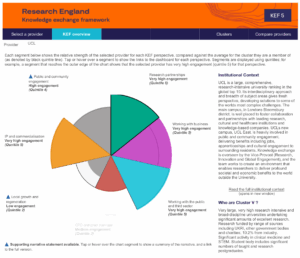
University College London (UCL) was rated among the top-performing universities for knowledge exchange. UCL places a strong emphasis on knowledge exchange and this marks the fifth consecutive year that UCL has achieved top recognition.
UCL achieved the highest possible ratings across several categories, including: Research Partnerships, Intellectual Property and Commercialisation, Working with Business and Working with the Public and Third Sector.
Over the past five years, UCL has launched 46 spinout companies, supported through its commercialisation arm, UCL Business (UCLB). Notable examples include:
Endomag – a breast cancer technology company now used in over 1,000 hospitals across 45 countries. More than 550,000 women are benefitting from the more precise and less invasive treatment.
Autolus – a spinout pioneering CAR-T cell therapy, helping adults with leukaemia, that has raised over $1.1 billion in investment. It is now been licensed for eligible patients in the US, UK and the European Union.
UCL’s entrepreneurial community also continues to thrive. Through BaseKX, its entrepreneurship hub, more than 400 student start-ups have been launched since 2019, collectively raising £356 million and creating 1,900 jobs.
UCL’s collaborative approach underpins its KEF success. Highlights include:
Establishing the UK’s first Global Industrial Technology Cooperation Centre with South Korean partners to advance hydrogen mobility and decarbonisation.
Co-founding the London Quantum Technology Cluster alongside King’s College London and Imperial College London, strengthening London’s position as a global quantum hub.
Partnering with Biogen on a breakthrough therapy for Friedreich’s ataxia, approved by UK regulators in 2025.
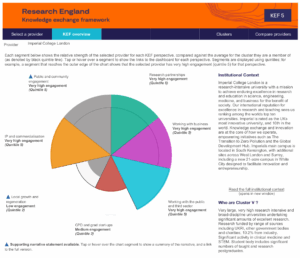
Imperial consistently achieves top marks across KEF categories including: Research Partnerships, Intellectual Property and Commercialisation, Working with Business, and Working with the Public and Third Sector. Its approach combines a strong entrepreneurial culture with a commitment to public engagement and local growth.
Imperial Enterprise and its enterprise ecosystem have supported more than 400 student and staff start-ups. Key spinouts include:
Autolus – pioneering CAR-T cell therapies for cancer, successfully raising significant global investment and progressing clinical trials in the US, UK, and Europe.
Notpla – developing sustainable packaging alternatives, winning the 2022 Earthshot Prize.
MediSieve – designing magnetic filtration systems to remove harmful cytokines from the blood of COVID-19 patients.
Through initiatives such as the Imperial Venture Mentoring Scheme (IVMS) and the Imperial Enterprise Lab, start-ups benefit from mentoring, workspace, and commercialisation support. These programmes have helped early-stage ventures survive and scale, with a 93% success rate at the Imperial White City Incubator.
Imperial works with over 500 industry partners annually to translate research into commercial applications. Flagship initiatives include:
Imperial Business Partners (IBP) Imperial’s flagship industry partnership programme
White City Campus (WCC) a 21-acre hub for innovation, hosting facilities such as the Translation and Innovation Hub (I-HUB), Scale Space, and the Imperial White City Incubator (IWCI)
Centre for Climate Change Innovation / Undaunted supporting climate-tech SMEs with pre-seed and early-growth funding, innovation brokerage, and networking
Imperial actively contributes to local growth and regeneration, and collaborates with local authorities, schools, and organisations to drive inclusive economic growth, provide training, and develop STEM skills.
Imperial College London continues to demonstrate how knowledge exchange can generate lasting impact, both locally and globally.

King’s has an ambitious Innovation and Knowledge Exchange agenda. Ranked as one of the top English universities for the fifth year running, King’s remain committed to investing in initiatives that drive research with a meaningful and lasting impact on the world.
Initiatives and projects led by King’s Policy Institute have strengthened King’s Local Growth and Regeneration score, highlighting the King’s dedication to supporting local communities and promoting inclusive growth. Notable examples include:
King’s Sanctuary Programme – lead initiatives that support forcibly displaced people through scholarships, digital learning, sponsorship schemes, and community engagement
Help to Grow – has helped more than 10,000 participants nationwide. It’s one of the most accessible leadership development programmes available, as 90% of the course cost is subsidised by the UK Government.
A university at the heart of London, King’s have five main campuses across the capital, with three co-located alongside major NHS hospitals, together with sites in Oxfordshire and Cornwall.
King’s Strategic Vision 2029 sets out bold ambitions for the future: “to make the world a better place through our excellence in education, research and our service to society.”
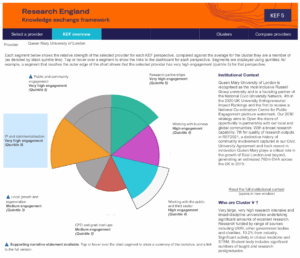
Queen Mary University of London maintained the highest possible score for the categories ‘IP and commercialisation, ‘research partnerships’ and ‘public and community engagement’
Queen Mary also report that they have “significantly improved its score for the category ‘continuing professional development and graduate start-ups perspective’, thanks to strategic investments made by the University in these areas”.
Their results highlight the university’s ongoing excellence in sharing knowledge, ideas, and expertise to drive economic and social benefit locally, nationally, and globally. The university also continues its commitment to being the most inclusive research-intensive university of its kind. The university further reports that “Queen Mary is committed to the new Whitechapel Life Sciences Quarter, a major strategic regeneration programme involving integration of the University, the NHS trust and the local community.”
Queen Mary launch several new spin-out companies each year. Through Queen Mary Enterprise and Innovation, the university is supporting researchers to commercialise breakthroughs in life sciences, digital technologies, and engineering. Queen Mary spinout companies raised £36m in investment in 2023/24.
Inflazome – a biotech spinout developing therapies for inflammatory diseases, acquired by Roche in 2020.
Lumen Bioscience – a synthetic biology company advancing sustainable health and nutrition solutions.
Queen Mary is committed to excellence in knowledge exchange is embedded in their Strategy 2030. It’s mission to “…generate new knowledge, challenge existing knowledge, and engage locally, nationally and internationally to create a better world.”

The world’s oldest English-speaking university, Oxford University combines academic excellence with a strong commitment to societal impact. Its research strengths span medical sciences, engineering, social sciences, and the humanities, with interdisciplinary collaboration driving innovation.
Oxford University consistently ranks among the top-performing universities for knowledge exchange. The university’s focus on innovation and collaboration has seen it achieve high ratings across key KEF categories, including Research Partnerships, Intellectual Property and Commercialisation, Working with Business, and Working with the Public and Third Sector.
Over the past five years, Oxford has launched more than 60 spinout companies through Oxford University Innovation and Oxford Science Enterprises.
Through initiatives such as the Oxford Foundry, researchers and students are supported to turn ideas into ventures, contributing to job creation, regional growth, and investment in innovation.
Another example of the impact of Oxford’s research, innovation and regional partnership activities is The Oxford Centre for Plant Science Innovation. A joint initiative with OxLEP, (now Enterprise Oxfordshire) funded through £1.9m of regional growth plus the University’s own funds, has now created two spin-out companies. The first, Wild Bio based in Abingdon Oxfordshire currently employs 20 people.
Oxford aim to maximise impact across all knowledge exchange and innovation channels. Strengthening their contribution to the Oxfordshire innovation ecosystem, ‘Region and Place’ is at the heart of Oxford’s Knowledge Exchange Strategy.
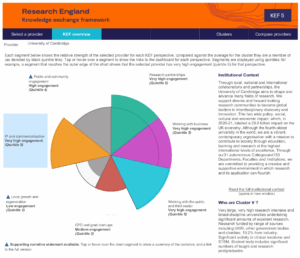
Despite being the fourth-oldest university in the world, Cambridge University remains a dynamic, forward-looking institution driven by a mission to benefit society through world-class education, learning, and research.
Cambridge achieved outstanding results across key areas, including: Research Partnerships, Intellectual Property and Commercialisation, Working with Business and Working with the Public and Third Sector.
Cambridge hosts Europe’s largest technology cluster. Over 5,300 knowledge-intensive firms around Cambridge are supported by its research, generating more than £18 billion turnover and employing nearly 70,000 people.
Its technology transfer arm, Cambridge Enterprise, lead over 65 programmes in entrepreneurship, innovation and commercialisation and coordinate a network of KE professionals who support early stage enterprises.
Cambridge’s entrepreneurial and ecosystem approach continues to thrive. Through ties with the surrounding region, including the Cambridge Biomedical Campus and the West Cambridge innovation district the university supports innovations and actively creates place-based infrastructure for growth.
Cambridge’s collaborative approach underpins its knowledge exchange success. Highlights include:
Hosting “Europe’s largest technology cluster” anchored by the University with strong global reach.
A broad ecosystem of partnerships across industry, government, NHS trusts, and global research networks.
Active engagement in regional growth: Cambridge engages with multiple local authorities in the region to drive sustainable and inclusive economic growth.

The University of Southampton is the only Science and Engineering South institution on the south coast, contributing over £1.3bn a year locally and driving a global research and innovation agenda. Ranked 4th in the Russell Group for Research Impact (REF 2021) and in the top 1% of universities worldwide, it brings together world-class, interdisciplinary strengths across seven campuses.
Southampton’s strategy is built on a “Triple Helix” model that tightly integrates education, research, and knowledge exchange. Its Civic University Agreement underpins deep partnerships across five local councils, focusing on priority areas such as future jobs, health and wellbeing, sustainability, culture, social justice, and economic growth.
Through the Southampton Science Park, the SETsquared Partnership, Future Worlds and the ICURe programme, it sustains a thriving ecosystem for commercialisation, spin-outs and SME growth. The university report that they have a “vibrant ecosystem for supporting innovation, commercialisation and spin-outs”.
Research and Innovation Services (RIS), deliver the central support for Knowledge Exchange, Impact, and commercialisation.
Flagship collaborations span climate and environmental resilience, clean maritime innovation, space technologies, digital design, and health research. The university is also deeply embedded in cultural and regeneration initiatives, including major programmes working with young people, schools, arts partners and local authorities.
Southampton is a founding member of Space South Central (2022), the largest regional space cluster in the UK.
Southampton is strengthening local opportunity, supporting inclusive growth, and helping shape a sustainable, prosperous future for the south.
Impact Through Collaboration
Collectively, Science and Engineering South universities demonstrate how world-class research, enterprise and community partnership drive real, lasting benefit for society and the economy.
Related stories:
King’s performs strongly for the fifth year running in the Knowledge Exchange Framework
Latest results demonstrate Queen Mary’s excellence in knowledge exchange
UCL rated as a leading university for knowledge exchange five years in a row
KEF 2025: Russell Group shines on research spin-out investment